

What Are the Zamora Archives?

Updated: 5 days ago
Zamora Vol. 1 is the story.
The Zamora Archives are the evidence.
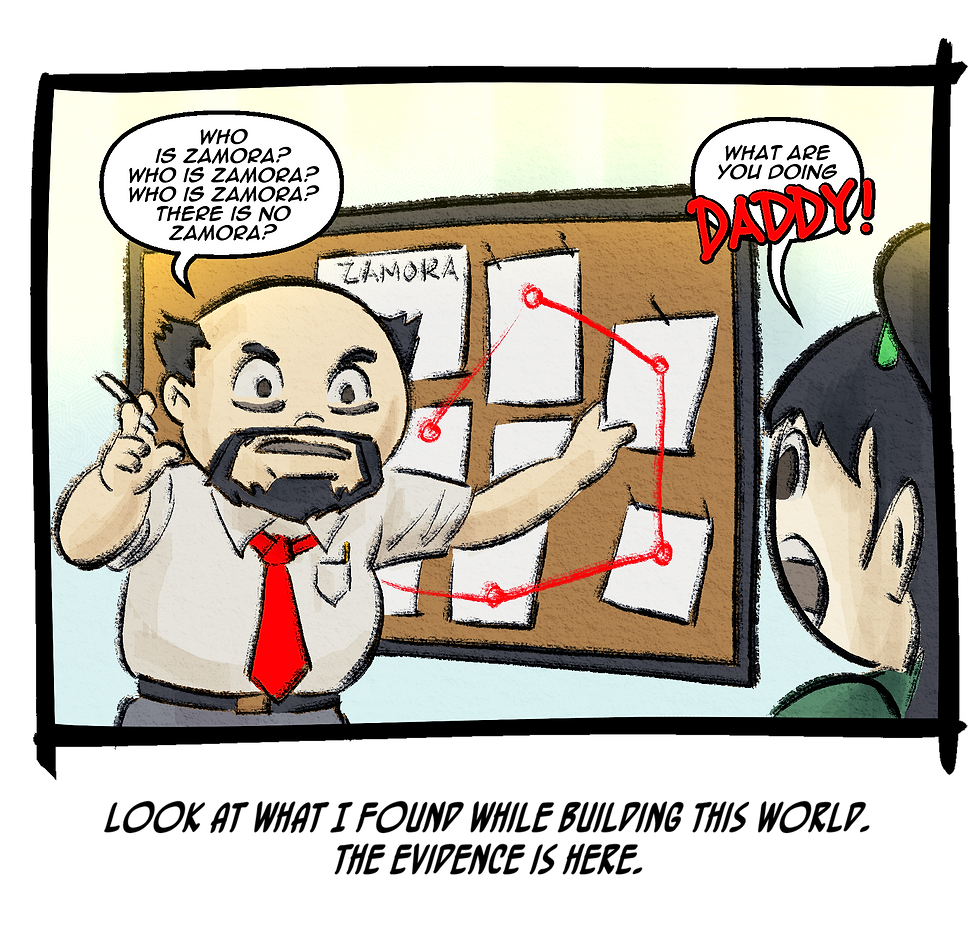
“Not everything you create is meant to become the final product. Some things exist to help you discover what the final product is. So don't throw away the messy stuff too quickly. It might be part of the story later.”
That Distinction Changed My Perspective on the Archives
When I first started working on Zamora, I wasn't thinking about making an archive. Honestly, I was just trying to make the damn comic! I had sketches, character designs, monster ideas, and notes scribbled on whatever was available. I even had pieces of mythology that didn’t have a home yet. Some ideas I wasn’t sure were good enough. Others I eventually rejected. And let’s not forget the ridiculous amount of information about things that may never even appear in the main story!
At some point, I realized: I had already created an entire pile of material surrounding the book. Instead of tossing it all away, I started asking a different question: What if all of this actually existed inside the world of Zamora? That’s when the Archives began to take shape.
The Story vs. The Evidence
Think about a horror movie for a second. You don’t always need to see the monster, right? Sometimes, it’s way more interesting to find the police report, the photograph, or the damaged tape. What about that strange symbol scratched into a wall? Or the witness statement that doesn’t quite make sense? How about a document that says: DO NOT OPEN.
That’s the feeling I wanted for the Zamora Archives. Zamora Vol. 1 tells you what happened. The Archives provide pieces of evidence that suggest what else is happening. That’s the difference! Zamora Vol. 1 = THE STORY and Zamora Archives = THE EVIDENCE. Suddenly, all those old sketches and notes had a purpose!
What’s Actually Inside the Archives?
The Archives are a treasure trove of information surrounding the horrors unleashed in Cagayan de Oro City. We’re talking about the Yawa, supernatural incidents, creatures, and mythology. And let’s not forget the much larger forces behind them! The world of Zamora isn’t just about demons lurking in the dark. There are cosmic entities and ancient forces at play—things that make the Yawa feel like just one piece of a much bigger puzzle.
And somewhere in the middle of all this chaos is the Cagayan Archdiocese Division of Exorcists - C.A.D.E. They’re the brave souls trying to document, understand, and stop these threats. Or at least, that’s the idea! I love the thought that the Archives could feel like they were assembled by people within that world—people trying to understand something they probably shouldn’t be looking at in the first place.
I Didn’t Want to Make Another Artbook
This was probably the most crucial creative decision I made. I didn’t want to create a typical artbook. You know the kind: “Here are my sketches. Here are my character designs. Here are some finished illustrations. The end.” There’s nothing wrong with that, but it wasn’t what I wanted for Zamora.
I wanted something that felt like somebody found a box of documents from the Zamora universe. A dossier! A collection of reports, photographs, monster studies, unfinished translations, strange symbols, field notes, concept art, rejected ideas, and sketches from years ago. Things that look like they were never meant to leave someone’s desk. That changes how you experience the artwork. You’re not just looking at a monster design; you’re investigating it!
The Artist’s Dilemma: What Do You Do With All the Stuff That Doesn’t Make the Book?
This is something I’ve learned from years of working on Zamora. Artists accumulate an enormous amount of material! A character gets redesigned, a monster gets cut, a scene changes, or a page gets abandoned. Sometimes, a mythology idea doesn’t fit the current story. Other times, a sketch gets replaced by something better.
Usually, we consider those things failures. But I don’t anymore! Sometimes they’re just evidence of development. That old monster design may show you where the final creature came from. That rejected character might contain an idea that becomes useful three years later. That terrible first sketch could reveal something about how your thinking has changed.
So here’s an artist tip I’ve learned the hard way: Don’t throw away everything just because it didn’t make the final product. Archive it! Label it, date it, and keep it. You don’t have to use it immediately. You may discover later that your “failed” material is actually part of the story of how you built the thing.
Give the Audience Something to Discover

This is where I want the Archives to become more than just a collection of artwork. I want the audience to feel like they’re finding something. Instead of just a label like “Monster Design #07,” maybe it becomes:
ARCHIVE FRAGMENT 07
ORIGIN: UNKNOWN
TRANSLATION: INCOMPLETE
LOCATION: REDACTED
KNOWN ASSOCIATIONS: C.A.D.E.
THREAT LEVEL: EXTREME
WARNING: DO NOT REPRODUCE SYMBOL

Then there’s the artwork. Maybe there’s a handwritten note in the corner. Perhaps something has been blacked out. Maybe there’s a strange symbol or a drawing that doesn’t quite match the written description. Maybe there’s one piece of information that raises more questions than it answers. That’s intentional!
I don’t want to explain everything. I want to create curiosity.

Your Audience Doesn’t Need the Whole Universe
This is another lesson I’m learning as an independent creator. When you’ve spent years building a world, you want to tell people everything! You know the history, the characters, what happened before the story, and what happens after it. You know the mythology behind the mythology. And you’re tempted to explain all of it.
But don’t! At least not all at once. Give people a doorway. One monster, one document, one character, one mystery, one strange image. Let them ask: “What is this?” That’s often more powerful than answering every question immediately. Curiosity makes people lean forward!
The Archive Is Also Part of the Worldbuilding
This is probably the part that excites me the most! The Archives aren’t just documentation about Zamora. They’re documentation from inside Zamora. That’s a subtle but significant difference.
If I draw a monster and put its name underneath, I’m showing you concept art. But if I show you a damaged field report written by someone who supposedly encountered that monster in Cagayan de Oro, suddenly you’re not just looking at artwork. You’re looking at evidence! And now the audience has a role. They’re not simply reading; they’re investigating. That’s the experience I want!
A Lesson I Wish I Learned Earlier
When I started Zamora, I thought every piece of artwork needed to serve the final comic. Now, I see things differently. Some artwork serves the story, some serves the world, some serves the audience, and some simply helps me discover what the hell I’m making.
That’s okay! Not everything needs to become a finished comic page. Sometimes a sketch exists because it helps you discover a character. Sometimes a monster design exists because it teaches you what kind of world you’re building. Sometimes a rejected idea isn’t wasted; it becomes part of the history.
That’s one of the advantages of creating your own IP. You’re not only creating the final product; you’re creating the world around the product.
Before and After
Before
I had a pile of sketches.
After
I have an archive.
Before
I had rejected ideas.
After
I have development history.
Before
I had monster designs.
After
I have evidence of creatures existing inside the world.
Before
I was making a graphic novel.
After
I’m documenting a universe.
And that changes how I see the project. Because Zamora Vol. 1 doesn’t have to contain everything. It only has to tell its story. The Archives can open the doors to everything around it.
So What Are the Zamora Archives?
They’re the things that happened before the book. They’re the things happening around the book. They’re the monsters, the sketches, the reports, the mythology, the rejected ideas, the concept art, the strange symbols, the things C.A.D.E. knows, the things C.A.D.E. doesn’t know, and maybe the things that nobody was supposed to find.
Most importantly: Zamora Vol. 1 is the story. The Zamora Archives are the evidence. And I’m going to start showing you that evidence. One fragment at a time, one monster at a time, one strange document at a time. Because I don’t want you to simply read Zamora. I want you to feel like you’ve discovered it.
Welcome to the Archives. Archive Fragment 01 is waiting. Just be careful what you uncover.
Subscribe to our newsletter:


Comments