

Why Horror? Because the Best Monsters Make You Question Reality.

I didn't fall in love with horror because I wanted to be scared. I fell in love with what happens after the fear.

“The best horror doesn't end when you close the book. It lives on in the questions you can't stop asking, the things you imagine in the dark, and the worlds your mind keeps building long after the story ends.”
Why horror?
It's a fair question.
Horror isn't everyone's cup of coffee. Some people can't stand blood, gore, or anything jumping out of a dark corner with the sole purpose of making them throw their popcorn across the room.
And honestly, I get it.
There's nothing wrong with a good jump scare. Sometimes, a monster appearing out of nowhere is all you need to have a good time.
But for me, the horror that sticks isn't necessarily the one that makes me scream.
It's the one that makes me stare at the ceiling afterward, wondering what the hell I just watched.
The kind that makes you question reality. The kind that takes something ordinary and makes it feel wrong. The kind that introduces an idea so disturbing that, even after the credits roll, a small part of your brain refuses to let it go.
What if that were real?
What if the world didn't work the way I thought it did?
What if the thing I was afraid of wasn't the real threat at all?
That's the kind of horror that fascinates me.
And, looking back, I think I've been chasing that feeling since I was a kid.
The Time Pennywise Ruined My Bathroom
Growing up, I watched all kinds of movies. Action, science fiction, adventure, horror. If a story could take me somewhere strange, put a character in an impossible situation, or introduce something I couldn't quite explain, I was interested.
I didn't have the vocabulary for storytelling back then. I wasn't thinking about narrative structure, character development, or thematic depth.
I just knew that some stories stayed with me longer than others.
Then I watched the original It.
You know, the one with Pennywise.
Bad idea.
For weeks afterward, I kept imagining that Pennywise would crawl out of the drain in our bathroom.
Every trip to the bathroom became a potential horror sequence. The drain wasn't just a drain anymore. It was a possible entrance to something that absolutely did not belong in my house.
And because I was a kid, my imagination didn't have an off switch.
It was basically a mental Olympics running twenty-four hours a day, inventing new ways for an imaginary clown to ruin my life.
I would overthink the situation, imagine the worst possible outcome, and then try to figure out how I would survive it.
Sometimes, that meant imagining myself as the hero who would somehow defeat the monster.
Other times, it meant crying by myself and hoping that thinking about something else would make the fear disappear.
A very sophisticated survival strategy, I know.
The interesting part is, even though I was terrified, I couldn't stop thinking about it.
My imagination kept asking questions. What if Pennywise really appeared? What would I do? How would I escape? Could I defeat it? What would happen next?
I wasn't simply remembering a scary scene. I was extending the story inside my own head.
The movie ended, but the story kept going.
And I think that's one of the most fascinating things about storytelling:
A good story can leave the screen, enter your imagination, and continue living there without the creator doing anything else.
As a child, I experienced that as fear.
As an artist, I eventually learned to recognize it as something else.
Curiosity.
Why Some Horror Is Scarier Than the Monster
As I grew older, my interest in storytelling expanded beyond the initial thrill of being scared.
I became fascinated by the ideas hiding underneath the monsters.
What makes a person become a monster?
What happens when the things we believe in turn out to be wrong?
What if the world is much bigger, stranger, and more dangerous than we can understand?
What if the thing we call evil is only one small part of something far worse?
These questions are what draw me toward horror, especially supernatural horror and cosmic horror.
The monster is important, of course. I'm a comic book artist. I love designing creatures, experimenting with silhouettes, figuring out how something moves, and discovering what makes a character visually disturbing.
But a monster that only looks scary can become forgettable.
Give that monster a history, a purpose, a weakness, or a disturbing connection to the human condition, and suddenly there's more to explore.
The creature becomes a question.
And the question becomes the story.
Think about the difference between seeing a strange figure standing in the dark and discovering that the figure has been standing there for a hundred years, watching the same family, waiting for something to happen.
The first image makes you nervous.
The second makes you wonder why.
That 'why' is where my interest begins.
I don't want to create horror that depends entirely on showing the audience something grotesque. I want to create stories that make people think, speculate, and perhaps question a few things they previously took for granted.
I want the audience to enjoy the experience, but I also want to give their imagination something to work with after the book is closed.
The goal isn't to explain every mystery. Sometimes, the most unsettling thing you can do as a storyteller is give the audience just enough information to imagine something worse.
What This Taught Me About Being an Artist
When I started drawing as a kid, I wasn't thinking about any of this.
I drew doodles. I designed characters. I copied and traced comics because I wanted to understand how the pictures worked and how artists made their stories come alive.
I didn't have a grand plan to build an original universe.
I was simply curious about the things I saw and the stories I consumed.
Over time, that curiosity became part of how I approached art.
And one lesson I've learned through my experience as a comic book artist and animator is that you don't always need to begin with a complete story. Sometimes, you begin with a question that refuses to leave you alone.
Here are three things I've learned from that process.
1. Don't just draw what looks cool. Ask why it exists.
It's easy to design a monster because it has sharp teeth, too many limbs, or a silhouette that looks great on a page.
There's nothing wrong with that. Visual appeal matters.
But when I want to develop an idea further, I start asking questions.
Where did this creature come from?
Why does it exist?
What does it want?
What makes it dangerous?
What does it reveal about the world it inhabits?
And, perhaps most importantly, what does its existence mean for the characters who encounter it?
You don't need to answer every question immediately. In fact, trying to solve everything before you begin can become another form of procrastination.
Start with the interesting part. Draw the creature. Explore the design. Let the answers emerge as you work.
A visual idea can lead to a character. A character can lead to a conflict. A conflict can reveal something about the world.
One drawing can become the beginning of something much bigger.
2. Use curiosity as fuel when inspiration runs out.
Creative work isn't always exciting.
There are days when the drawing doesn't work, the client revisions keep coming, the schedule gets ridiculous, and the personal project you care about most gets pushed to the bottom of the list.
I've experienced that struggle myself.
When you're trying to make a living from creative work, it's easy to spend so much time producing things for other people that your own ideas barely get a chance to breathe.
That's why I think curiosity is more useful than waiting for inspiration.
Instead of asking, "Do I feel inspired enough to work on this today?" try asking a smaller question:
"What can I discover about this idea in the next thirty minutes?"
Maybe it's a character's expression. Maybe it's a creature's anatomy. Maybe it's a page that isn't working or a piece of mythology you haven't figured out yet.
You don't have to solve the entire project in one sitting.
You just have to give yourself something worth exploring.
Over time, those small discoveries accumulate. A sketch becomes a character study. A character study becomes a story. A story becomes a finished page.
The progress may feel insignificant in the moment, but the finished work is built from those moments.
3. Give the audience something to wonder about.
As artists, we can become obsessed with showing people how much work we've done.
We want to explain the world, introduce every character, reveal the mythology, and prove that the project has depth.
I've learned that more information doesn't automatically create more interest.
Sometimes, it overwhelms the audience before they have a reason to care.
Instead, give them one compelling image. One strange detail. One unanswered question.
Let them discover the rest gradually.
A monster's silhouette might be enough to make someone curious. A cryptic note might make them wonder what happened. A character's strange behavior might suggest a history that hasn't been revealed yet.
The trick is to create a question that the audience actually wants answered.
You don't need to show them the entire universe at once.
You need to give them a reason to enter it.
From Childhood Nightmares to Zamora
This is where my fascination with horror eventually led me to Zamora.
I wanted to create a horror universe rooted in the Philippines, drawing from Filipino mythology, Catholic imagery, supernatural beliefs, and the kinds of questions that keep me interested in the genre.
At its center is Father Zamora, a 100-year-old Filipino priest fighting supernatural threats most people don't even know exist.
But I didn't want to stop at a priest fighting monsters.
I wanted to explore the creatures, the forces behind them, and the mysteries that make the world feel larger than the story happening on the page.
What are the Yawa?
What happens when a human becomes something else?
What exists beyond the things people call Heaven and Hell?
What might be hiding beneath a familiar city like Cagayan de Oro?
And what happens when the people trying to understand these things discover that they don't understand nearly enough?
I don't necessarily want to answer every question immediately.
Some mysteries need room to breathe. Some discoveries should change the way readers interpret what they've already seen.
That's part of the fun of building a universe. You can tell one story while leaving traces of something much larger in the background.
And because I'm building Zamora as an independent creator, I get to explore those ideas through the work itself: the graphic novel, the creature designs, the mythology, the sketches, and the documents that help make the world feel real.
Which brings me to two things I've been working on.
Zamora Vol. 1 Is the Story. The Archives Are the Evidence.
The first is Zamora Vol. 1, the graphic novel that introduces readers to this world.
It's the doorway.
You meet the characters, encounter the horror, and begin discovering what makes this universe different.
But a doorway is only useful if there's something beyond it.
That's where the Zamora Archives come in.
While developing Zamora, I've accumulated sketches, creature designs, notes, visual experiments, worldbuilding ideas, and pieces of mythology that don't necessarily belong in the main narrative.
At first glance, these might look like ordinary development materials. Things an artist produces while trying to figure out a project.
But I started looking at them differently.
What if they weren't simply behind-the-scenes material?
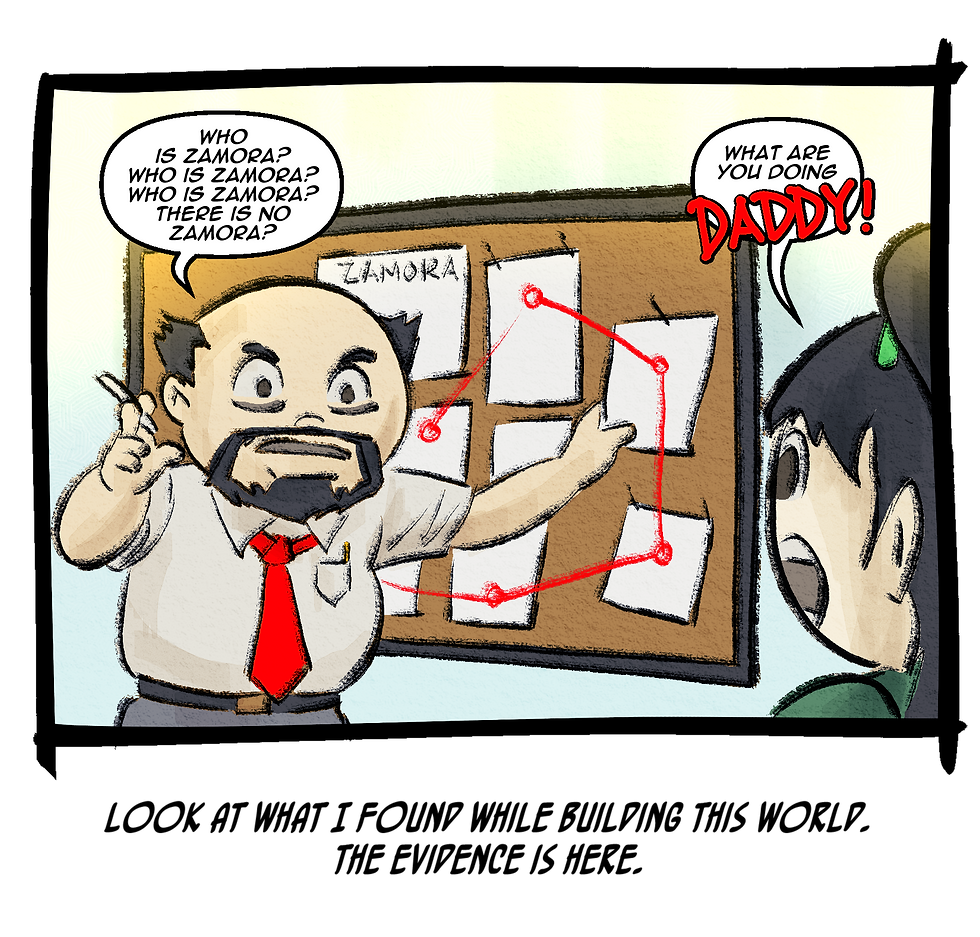
What if they felt like evidence collected from inside the world of Zamora?
What if a creature design became a field report? What if a strange symbol came with an incomplete translation? What if a document suggested that something had happened in Cagayan de Oro, but the details were missing, damaged, or deliberately redacted?
Suddenly, the material could do more than show how I created the comic.
It could deepen the experience of reading it.
That's the idea behind the Zamora Archives: fragments of a fictional world presented through the perspective of people trying to document and understand its horrors.
Zamora Vol. 1 is the story. The Zamora Archives are the evidence.
And this connects directly to the kind of horror that fascinated me as a child.
Remember Pennywise and that bathroom drain?
The fear wasn't just about what I'd already seen. It was about what I imagined might happen next.
I want to bring a little of that experience into Zamora.
Not by making readers afraid of their bathrooms, necessarily. I'd prefer not to be held responsible for that.
But by giving them images, details, and mysteries that make them wonder what else exists beyond the page.
The graphic novel gives you the story.
The Archives invite you to investigate the world around it.

The Lesson: Make Something That Stays With People
Looking back, I can see a connection between the kid who imagined monsters coming out of a drain and the artist who now spends his time drawing supernatural creatures and building fictional worlds.
The materials have changed.
The curiosity hasn't.
I still want to know what happens when someone encounters something they can't explain. I still want to explore the questions that emerge when the familiar becomes strange. And I still believe that stories can do more than entertain us for a few minutes.
They can make us feel something, challenge an assumption, or leave us thinking about an idea long after the experience ends.
That's what I want to pursue through my work, whether it's a comic, an animation, or a game.
I won't pretend every story I make will achieve that. Creative work is full of experiments, mistakes, revisions, and ideas that don't turn out the way you imagined.
But I'd rather make something, learn from it, and try again than wait for the perfect idea that never arrives.
And that's another lesson for artists:
You don't have to know whether an idea will become something great before you begin working on it. You just have to be curious enough to find out.
A doodle can become a character.
A character can become a story.
A story can become a universe.
And a universe can become something people want to keep exploring.
That's what I'm trying to build with Zamora.
If you want to experience the world for yourself, start with Zamora Vol. 1, the graphic novel that opens the door.
Then explore Zamora Archives #001, where the evidence, creature studies, and strange fragments begin to reveal more of what's hiding behind the story.
I built this world because I wanted to explore the things that fascinated me, frightened me, and made me ask questions as a kid.
Now I want to see what happens when those questions find their way into someone else's imagination.
Because the best horror doesn't end when you close the book.
Sometimes, that's when it really begins.
Enter the world of Zamora. Read the story. Examine the evidence. And be careful what you discover.
Subscribe to our newsletter:
Product Links:
#thescribblemedia #indiebasedstudio #animation #comics #webtoon #webcomics #services #platform #illustrationservices #computer #freelance #comicsandmanga #filipino #bisaya #bisdak #clipstudiopaint #clipstudio #clip #studio #ipadpro #tutorial #beginner #tips #videotips #newsletter #inspiration #art #creativedad #struggleofacreativedad #artistdad #artisticmomentum #creativehabits #buildingsystems #atomichabits #atomichabitsbyJamesClear



Comments