

I’m Not a Successful Artist Yet. I’m Building Anyway.

On creative envy, surviving the freelance grind, and why I’m giving myself one year to turn Zamora into a video game.

“Someone else's progress is not proof of your failure. Put the phone down, make the thing, and give your own dreams a chance to exist.”
Introduction: The Artist Who Never Made It
Sometimes, I look at the people I started with in the comic book industry and wonder what the hell happened to me.
Some of them are now working with major publishers, famous brands, and established franchises. They’ve made names for themselves. Their careers have taken them places that, at one point, I imagined mine might go.
Meanwhile, here I am, still jumping between comic illustration, 2D animation, and video game development just to keep the bills paid.
I run a small creative studio that has gone through more pivots than I care to admit. I’ve spent more than a decade trying to make a living from art, and sometimes it feels like I’m still figuring out how to survive the next month.
One day, I’m drawing comic pages. The next, I’m animating something for a client. Then I’m trying to figure out how to turn my studio into a sustainable business, only to find myself back where I started: looking for the next project.
It can feel like an endless cycle of finding work, finishing work, getting paid, and doing it all over again.
So, how do I survive?
The honest answer is that I don’t always feel like I’m surviving. Sometimes, I’m just moving from one problem to the next and hoping I can keep going.
I call myself a failed comic book artist. Not because I’ve stopped making comics, but because I’ve spent so much time measuring my life against what I thought success was supposed to look like.
And social media makes that comparison almost impossible to avoid.
You open your phone to check one thing, and suddenly you’re looking at someone announcing a major project, landing a dream job, launching a successful business, or posting a portfolio that makes you question every artistic decision you’ve ever made.
Meanwhile, you’re sitting at your desk wondering whether you should even bother finishing the page you started last night.
You know the advice: Don’t compare yourself to others.
Easy to say. Harder to practice when everyone’s highlight reel is sitting right there in your pocket.
But recently, I came across a piece of advice that stuck with me.
Who cares?
The people you compare yourself to are busy living their own lives. They have their own problems, ambitions, insecurities, and people they’re comparing themselves to. Most of them probably aren’t spending nearly as much time thinking about you as you imagine.
They’re busy with their own stories.
And so are you.
That thought gave me a little breathing room.
Maybe I don’t need to win the same race as everyone else. Maybe I just need to stop watching other people run long enough to work on the things I actually want to create.
Because I still have dreams.
And I’m tired of letting the internet convince me that I’m too late to pursue them.
The Deep Dive: The Problem Isn’t That I’ve Run Out of Dreams
The problem is that I have too many things I want to do, too little time to do them, and an industry that doesn’t always reward the work I care about most.
I want to make comics. I want to animate. I want to develop video games. I want to build a sustainable creative studio. I want to create original stories that people remember long after they’ve finished reading them.
I also want to spend time with my family without feeling guilty that I’m not working.
But freelance work has a way of taking over everything.
Client deadlines have dates. Personal projects have excuses.
A client needs an animation by Friday, so the comic gets pushed back. The comic needs another round of revisions, so the game prototype waits. The prototype gets complicated, so I tell myself I’ll return to it when I have more time.
And when does that magical free time arrive?
Usually, it doesn't.
There will always be another deadline, another revision, another unexpected expense, or another reason to postpone the thing you actually want to make.
Before you know it, months have passed. You’ve completed plenty of work, but most of it belongs to someone else.
There’s nothing wrong with client work. It pays the bills, develops your skills, and introduces you to new challenges. I still need it, and I’m grateful for the opportunities it gives me.
But I started asking myself a difficult question:
If I spend all my creative energy building other people’s projects, when will I build my own?
That question became harder to ignore as I watched generative AI change the creative industry. The market keeps shifting. Expectations change. Clients have budgets. Competition gets tougher.
I can spend my life trying to predict what the industry will do next, or I can spend some of that time building something I actually own.
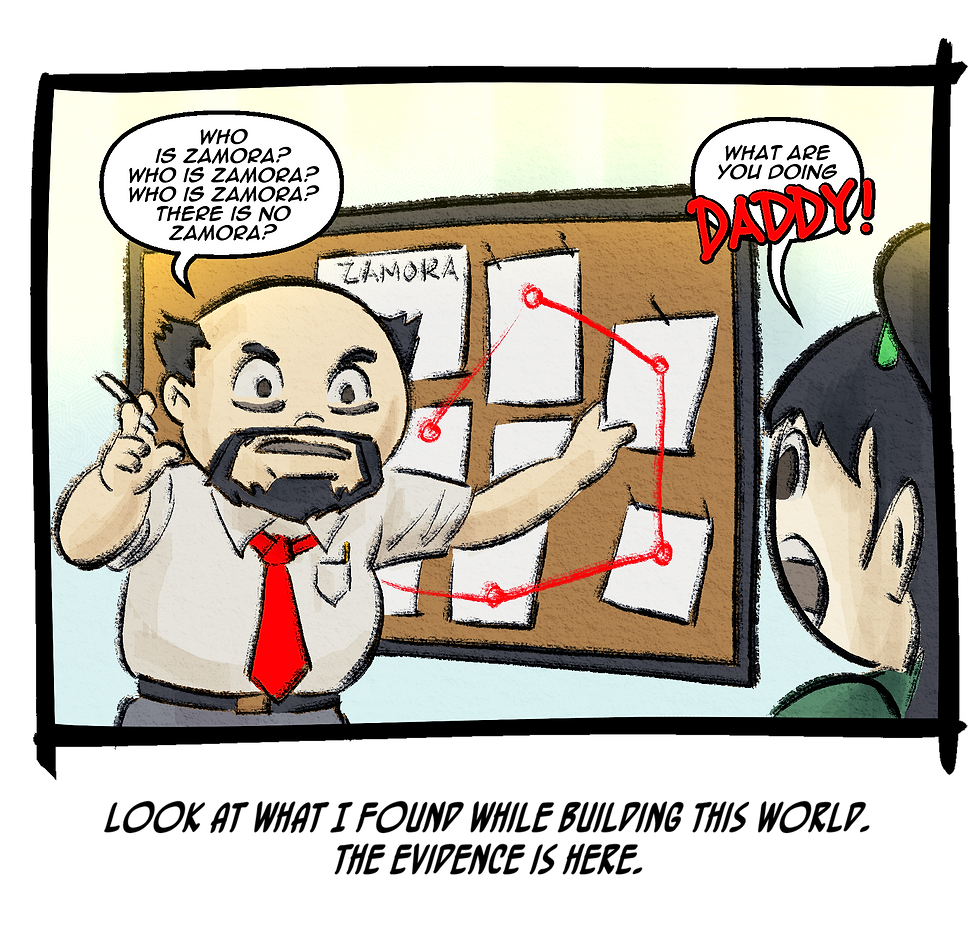
For me, that means continuing to develop Zamora.
I recently launched the first volume of my horror graphic novel at a convention. That was a milestone I had been working toward for a long time. I could have stopped there, celebrated, and waited until I felt ready for the next big project.
Instead, I started working on the next thing.
A video game.
Why a video game?
Why not?
It has been a lifelong dream of mine to create one. And since Zamora already has a world, characters, creatures, and stories, I started wondering what it would be like to let people explore that world instead of only reading about it.
I wanted to see Father Zamora move through a haunted forest, descend into caverns, and face the nightmares that inhabit his universe.
Not just in a comic panel. As a playable character.
So I gave myself a challenge: build a playable prototype within a year, or less if I can manage it.
There's just one small problem.
I don't know everything I need to know to make a video game.
Drawing a game is not the same as making a game.
As a comic artist and animator, I thought I had a reasonable head start.
I know how to draw characters. I know how to design monsters. I know how to animate sprites and create visual assets. I can develop the art direction and imagine how the game should look and feel.
Surely that would make things easier.
Wrong.
Making the art is one thing. Making it work inside a game is another.
A character can look fantastic in a drawing and still feel terrible to control. An animation can look smooth on its own but fail when it needs to respond to player input. A beautifully designed environment doesn't automatically become an interesting level.
And then there’s the code.
The engine has to understand what the character is doing, when the animation should play, how the player interacts with the environment, how enemies behave, and what happens when everything goes wrong.
Then I have to think about the actual game mechanics.
What makes the game fun? What makes the player want to keep going? How do I turn a collection of art assets into a playable experience instead of an interactive slideshow?
These are different problems from the ones I solve when I draw a comic page.
I’m learning through tutorials, courses, experimentation, and plenty of trial and error. Sometimes, I make progress. Sometimes, I discover that the thing I thought would take an hour requires me to understand three other things first.
And sometimes, I wonder whether I’ve bitten off more than I can chew.
But I keep coming back to one thought:
I don't have to know how to make the entire game today. I only have to learn enough to make the next part work.
That distinction matters.
Because when you look at a dream in its entirety, it can feel impossible. When you look at the next small step, it becomes something you can actually do.
And that brings me to the one system that has helped me more than waiting for motivation ever did.


The Solution: The Artist’s Compound Interest Principle
Over the past several months, I’ve been applying the principles of Atomic Habits to my creative work.
The idea is simple: make the actions you want to repeat small enough to fit into your life, then keep repeating them.
You don't need to transform your entire routine overnight. You don't need to wait for a burst of inspiration or clear your schedule for an imaginary month of uninterrupted creativity.
You need a way to return to your work, even when life gets in the way.
I think of this as the Artist’s Compound Interest Principle.
A sketch becomes a character. A character becomes a story. A story becomes a comic page. Pages become chapters. Chapters become a book. And a book can become the foundation for an entire universe.
None of those steps look particularly impressive on their own.
But repeated over time, they add up to something that didn't exist before.
The same principle applies to learning a game engine, developing a business, or building an audience. Small actions create opportunities for the next small action. Your knowledge grows, your skills improve, and your projects become less intimidating because you have already started.
This is not a promise that every small action will lead to success. Some experiments will fail. Some ideas won't work. Some projects will take longer than expected.
But you give yourself a much better chance of finishing something when you keep showing up to work on it.
Here are a few things I’m learning and applying as I build my game while continuing to work on my comics.
1. Stop measuring your progress against someone else's timeline
This is easier said than done, especially when you're surrounded by artists who appear to be doing better than you.
But your career isn't a race with a single finish line.
Someone else might have landed a major publishing deal. Someone might be working on a game you've admired for years. Someone might have built a studio with a team, a big portfolio, and a long list of clients.
Good for them.
You can admire what they've accomplished without turning their success into evidence of your failure.
When comparison starts getting in the way of your work, try changing the question.
Instead of asking, "Why am I not where they are?" ask, "What can I make with the time and resources I have today?"
That question brings you back to something you can control.
For me, that might mean drawing one creature for Zamora, fixing one animation, learning one engine feature, or making a small improvement to my studio's business.
It might not look impressive on social media.
It still counts.
2. Put the phone down and make something
Social media can be useful. It's how we discover artists, share our work, meet potential clients, and find communities that care about what we're making.
I'm not suggesting that you disappear from the internet forever.
But there's a difference between using social media to support your creative work and using it to avoid your creative work.
I've lost time scrolling through other people's projects when I could have been working on my own. I've watched tutorials, read advice, and collected ideas, only to finish the day without producing anything.
Sometimes, research is necessary. Sometimes, we're just procrastinating with better branding.
So I’m trying to be more deliberate about when I consume and when I create.
Before opening an app, ask yourself what you're there to do. Are you researching a specific problem? Sharing a finished page? Connecting with readers? Or are you simply looking for a distraction from the uncomfortable feeling of starting?
If you have a personal project waiting for you, give it a little time before you open the feed.
Draw. Animate. Write. Develop.
Make something that didn't exist when you woke up.
You can post it later.
3. Make the habit smaller than your ambition
When I decided to develop a Zamora game, I could easily have spent weeks planning the entire project.
I could have mapped out every level, designed every monster, written a huge document about the game's systems, and imagined a complete experience with polished art and music.
Planning feels productive because you can see the dream taking shape without confronting all the difficult parts of making it real.
But I don't need a perfect plan for the entire game. I need a playable prototype.
That means breaking the work into manageable tasks.
One session might be spent learning how to move a character. Another might focus on an animation. Another might be devoted to getting an enemy to respond to the player. Some days, the only useful thing I accomplish is discovering why something doesn't work.
That's still part of the process.
If you're struggling to make progress on your own project, lower the entry barrier.
Instead of committing to finishing a whole comic page, start by opening the file and sketching one panel.
Instead of promising to animate for three hours, work on one movement.
Instead of trying to master an entire game engine, learn one feature you need for the prototype.
The point isn't to make your ambitions smaller. It's to make starting easier.
And once starting becomes easier, you have a better chance of returning tomorrow.
4. Build a routine that survives client work
My personal projects have to coexist with paid work. That's the reality of being an independent artist.
I can't always dedicate an entire day to Zamora. I can't assume that every week will be quiet or that clients will politely wait while I pursue my dreams.
So I need a system that works even when my schedule isn't ideal.
For me, that means dividing the day into manageable blocks and using small habits to maintain momentum. I can make time for the game, continue developing the comic, and still meet my professional responsibilities.
I don't have to work on every project every day. I do have to be honest about what each project needs and when I'll return to it.
If you have several creative goals, give each one a clear next action. Keep a note of where you stopped. When you return to the project, you won't have to spend half your session remembering what you were supposed to do.
And when a client deadline takes over the week, don't treat that interruption as proof that your routine has failed.
Resume when you can.
A sustainable creative practice isn't one where nothing ever goes wrong. It's one you can return to after something does.
5. Learn by building, not just by studying
I'm learning how to use a game engine while building the Zamora prototype. Tutorials help, but watching someone else make a game is not the same as making one yourself.
You can understand a technique while watching a video and still have no idea how to apply it to your own project.
That's why I want every learning session to connect to something I'm actually trying to build.
If I learn how to implement character movement, I want to use it in the prototype. If I learn how to trigger an animation, I want to see Father Zamora perform that action in the game. If I study enemy behavior, I want to make one of the creatures in my world behave like a real threat.
This gives me a reason to learn and a way to test whether I've understood the lesson.
It also means accepting that the first version will be rough.
The prototype doesn't need to look like a finished commercial game. It needs to demonstrate the core experience and help me discover what works.
A finished tutorial gives you information. A working prototype gives you information and something you can test.
So don't wait until you're an expert to begin your project.
Build something small enough that you can learn while making it.
6. Define what “finished” means before the project grows
Creative projects are dangerous because they can always become bigger.
You add another character, another level, another feature, another animation. Every new idea seems reasonable in isolation, but together they can turn a manageable project into something you can never finish.
For the first Zamora game prototype, I need to resist that temptation.
My goal is to make a small, playable experience featuring Father Zamora, a handful of environments, and a limited set of enemies and bosses. I want to explore the feeling of surviving a supernatural nightmare in the world I've been building through comics.
That is the first milestone. Not the complete game. Not every creature in the lore. Not every story I eventually want to tell.
Just a playable prototype that gives people a taste of what this game could become.
The same principle applies to comics.
Finish the chapter before planning the next five volumes. Complete the page before redesigning the entire book. Give yourself a definition of done that you can actually reach.
You can always expand a project after you have something real to build on.
7. Let your projects talk to each other
One reason I'm excited about making a Zamora game is that I don't have to begin with an entirely new universe.
I've already spent time developing its characters, monsters, visual identity, and mythology through the graphic novel and webcomic.
That work gives me a foundation for the game.
The game, in turn, can help me explore the universe in a different way. Readers experience the story through panels and pages. Players can experience its environments, dangers, and mechanics through interaction.
These are different creative disciplines, and each has its own challenges. I can't simply copy a comic into a game and expect it to work.
But I can let the work I've already done inform what comes next.
If you're an artist with several ambitions, look for the connections between them. A character design could become a short animation. An illustration could become part of a larger story. A comic could inspire a game prototype. A technical skill you develop for one project might solve a problem in another.
You don't need to turn every idea into a separate business or a completely new project.
Sometimes, the best way forward is to build on what you already have.
The Experiment: One Year of Building Anyway
Right now, I'm working toward a playable Zamora prototype within one year, or less if I can manage it.
Alongside that, I'm continuing production on Zamora Volume 2 and the webcomic. Episode 42 is also in development.
I'm not pretending that balancing all of this will be easy. I still have client work to do. I still have to learn unfamiliar tools. I still have a family and a life outside the studio.
There will be days when I make substantial progress and days when I barely move the needle.
The goal is to keep the projects alive without pretending that I have unlimited time or energy.
I want to document the process honestly: what I learn, what breaks, what takes longer than expected, and what finally works.
I want to show the messy middle of making something original, not just the polished image at the end.
And I want to find out what happens when I stop treating my dreams as things I'll pursue someday and start treating them as projects I can work on today.
My process is simple:
Learn. Create. Implement. Deviate. Prototype. Repeat.
Learn the skill. Create the asset. Implement it in the game. Deviate when the original plan doesn't work. Test the result. Then do it again.
It won't always be elegant. It certainly won't always be fast.
But I believe the work will teach me things that planning alone never could.

Before and After: From Comparing Careers to Building One
Before, I spent too much time looking at other artists' careers and wondering why mine hadn't turned out the same way. I kept moving between client projects, business ideas, and postponed personal ambitions, hoping that one day I'd finally have enough time to make the things I wanted to make.
Now, I'm trying a different approach.
I'm still a freelancer. I'm still learning. I'm still figuring out how to make my studio sustainable. I haven't magically solved the problems that come with making a living from creative work.
But I can choose what I do with some of my time.
I can spend another hour comparing my progress with someone else's, or I can spend that hour making a piece of my own future.
I can wait until I feel qualified to make a video game, or I can learn the next thing I need to build a prototype.
I can keep telling myself that I'll return to my comic when life gets easier, or I can make a little progress and return to it again tomorrow.
That doesn't guarantee fame, financial security, or a successful game. I won't pretend it does.
What it gives me is a way to move forward without waiting for those things to arrive first.
And right now, that's enough to keep going.
I'm Not Done Yet
I used to think that by this point in my career, I'd have figured everything out.
Maybe I'd be working on major franchises. Maybe my studio would be thriving. Maybe I'd have a much clearer answer when someone asked what I do.
Instead, I'm still drawing comics, animating for clients, developing my studio, learning game development, and trying to build something that belongs to me.
Some days, that feels like failure.
Other days, I remember that the graphic novel I once wanted to publish is now a physical book. The world of Zamora exists beyond my sketchbook. People have bought it, read it, and taken it home.
That happened because I kept working on it.
Now, I want to see that world become playable.
I want to build the prototype. I want to continue Volume 2. I want to keep making webcomic episodes. And I want to discover how far these small, repeated efforts can take me.
Maybe I'll finish the prototype within a year. Maybe I'll discover that certain parts take longer than I expected. Either way, I'll have learned by building instead of merely wondering whether I could do it.
So, if you've been putting off your own creative project because you're too busy comparing yourself to other people, here's my advice:
Put the phone down for a little while.
Open the file. Draw the panel. Animate the movement. Write the scene. Learn the tool. Make the prototype.
You don't need to prove that you're better than someone else.
You don't need to have your entire career figured out.
You just need to give your own work a chance to exist.
As for me, give me one year.
I'm going to try to make a playable game out of Zamora while continuing to build the comic universe that started it all.
I don't know exactly how this experiment will turn out.
But I'm done waiting to feel like a successful artist before I start acting like a creator with something worth building.
I'm not successful yet. I'm building anyway.
And I'll let you know how it goes.
Subscribe to our newsletter:
Product Links:
#thescribblemedia #indiebasedstudio #animation #comics #webtoon #webcomics #services #platform #illustrationservices #computer #freelance #comicsandmanga #filipino #bisaya #bisdak #clipstudiopaint #clipstudio #clip #studio #ipadpro #tutorial #beginner #tips #videotips #newsletter #inspiration #art #creativedad #struggleofacreativedad #artistdad #artisticmomentum #creativehabits #buildingsystems #atomichabits #atomichabitsbyJamesClear




Comments