

The Convention Is Over. Now Comes the Harder Part: Selling What’s Left.

Anyone can celebrate a successful launch. The real test of an independent creator begins when the convention lights go off.

“A product sitting unsold is not a failure. It’s a story that hasn’t reached the right person yet.”
Introduction: The Convention Hangover
One week later, and Cagayanime 2026 still feels like yesterday.
I'm still mentally recovering from it.
Three days of conversations.
Three days of people stopping at Booth M03.
Three days of selling Zamora Volume 1, Lorebooks, stickers, shirts, sketch cards, and talking to people who wanted to know how everything was made.
After months of preparing, stressing over printers, fixing a failed print run, relighting 100 pages, redesigning layouts, and wondering whether anyone would care...
The event was a success.
Then Monday arrived.
And suddenly, the convention was over.
No more crowds.
No more people walking past the booth.
No more spontaneous conversations with someone who stopped because a character caught their eye.
Instead, I was back to something much quieter.
Packing books.
Shipping reserved copies.
Delivering orders.
Following up on unpaid reservations.
Checking messages.
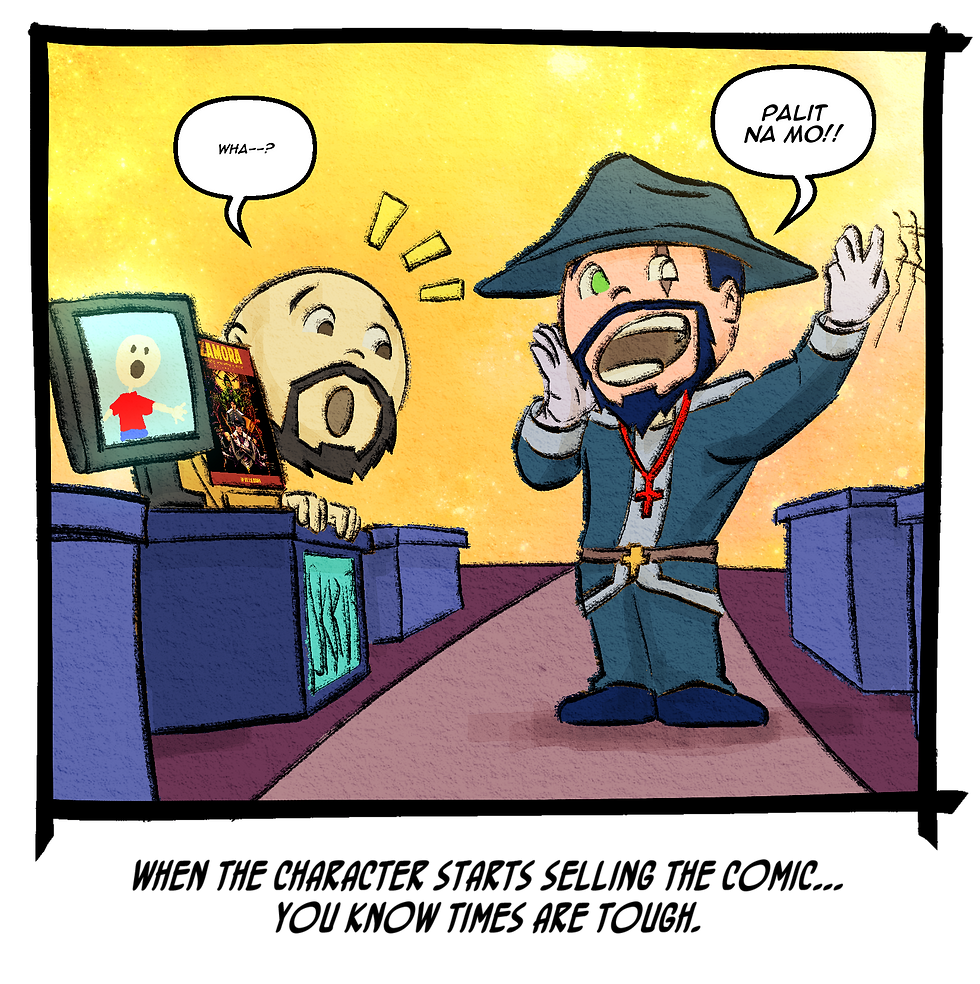
And looking at the copies of Zamora Volume 1 that were still sitting there.
That was when the post-convention reality finally hit me.
Selling at a convention and selling after a convention are two completely different games.
At the convention, I had foot traffic.
After the convention, I have to create it myself.
And that's the problem I'm trying to solve now.

The Deep Dive: The Convention Gave Me Attention. Now I Need to Build a Funnel.
At Cagayanime, people discovered Zamora by accident.
They were already there.
They were walking around.
They saw the booth.
Something caught their attention.
Then maybe they stopped.
After the convention?
Nobody is accidentally walking past my table anymore.
So the question becomes:
How do I bring people back to the comic when the convention is gone?
My first instinct was simple.
"Make more content."
Which is technically correct.
But it's also dangerously vague.
Because "make more content" can quickly become:
Post more art.
Post another sketch.
Post another character.
Post another promotional image.
Then wonder why people are liking the posts but not buying the book.
That's the problem.
Attention and intention are not the same thing.
Someone liking a Zamora illustration doesn't automatically mean they are ready to buy Volume 1.
Someone sharing a post doesn't mean they understand what the comic is about.
And someone who attended Cagayanime may not even realize that copies are still available.
That's why simply posting more isn't enough.
The content needs a job.
I call this:
The Post-Convention Funnel Principle
Every piece of content after a launch should help move someone from:
"What is this?"
to:
"That's interesting."
to:
"I want to know more."
to:
"Where can I get it?"
to:
"I should probably buy this before it's gone."
That doesn't mean every post needs to scream:
BUY MY COMIC.
Honestly, that would probably annoy me too.
Instead, the content needs to do what the convention booth did naturally.
It needs to start a conversation.
Emotion Commits the Crime. Logic Does the Cover-Up.
At the convention, people didn't stop because they had carefully researched the financial value of Zamora Volume 1.
They stopped because something made them curious.
A character.
A cover.
A creepy image.
A familiar Filipino mythological element.
The fact that a local creator made a graphic novel.
Emotion got them to stop.
Then logic helped them justify the purchase.
"That looks interesting."
"It's locally made."
"I like the art style."
"I've been wanting to support Filipino comics."
"I can afford this."
"I'll read it."
That's an important lesson for me moving forward.
Because if I want to sell the remaining copies, I can't only post the product.
I need to remind people why they should care about the world behind it.
The comic itself is the product.
But the story behind the comic is often what opens the door.
The failed print run.
The years it took to build Zamora.
The mythology.
The local setting.
The characters.
The creative process.
The fact that this started as an idea and somehow became a physical graphic novel sitting in someone's hands.
That's where the emotion lives.
And then the product becomes the logical next step.
The Unsold Copy Problem
There is a psychological problem with unsold inventory.
When you're standing in front of a stack of remaining books, your brain starts telling you:
"I need to get rid of these."
And that's dangerous.
Because "getting rid of inventory" can lead to desperate marketing.
Sudden discounts.
Constant promotions.
Begging for attention.
Posting the same sales image repeatedly.
But I'm trying to look at the remaining copies differently.
They're not garbage.
They're not failed copies.
They're simply books that haven't found their readers yet.
That changes the strategy.
The question is no longer:
"How do I get rid of these?"
It's:
"Where are the people who would actually want to read these?"
And that leads to two different paths.
Path One: Build Content That Leads Somewhere
The first path is building a deliberate content funnel.
Not random content.
Content with a destination.
For Zamora, I can think about it in layers.
At the top are the people who don't know me.
They might discover a creepy illustration, a character design, a piece of Filipino mythology, or a behind-the-scenes story.
They're not buyers yet.
They're strangers.
So the content should earn their attention.
Then there are people who already know about Zamora.
These people need more reasons to become interested.
Maybe I show:
How the graphic novel was made.
Why I created the world.
The mythology behind a monster.
The printing disaster.
The evolution of the artwork.
The story behind Father Zamora.
What readers experienced at Cagayanime.
Then come the people who are already interested but haven't bought.
This is where I can answer the questions stopping them:
What is Zamora about?
How many pages is it?
What kind of story is it?
Who is it for?
Where can they get it?
How much is it?
Is it still available?
The biggest lesson?
Don't make every piece of content a sales pitch.
Make the journey interesting enough that the sale becomes the next logical chapter.
Path Two: Get the Books Where Readers Already Are
The second option is something almost every independent publisher eventually has to consider.
Resellers.
Bookstores.
Comic book stores.
Specialty shops.
Stores that already have the audience I'm trying to reach.
Because right now, Zamora can sit in my studio waiting for someone to discover it.
Or I can try to put it somewhere readers are already looking.
That's the advantage of a reseller.
They already have:
Foot traffic.
An audience.
A location.
Trust.
Customers who are actively looking for books, comics, or collectibles.
But of course...
There's another problem.
Why should they sell my comic?
That's the difficult part.
And I think many self-published creators make the mistake of approaching a store with only one argument:
"Please carry my book."
That's not a business proposition.
That's a favor.
A bookstore or reseller is thinking about different questions:
Will this sell?
Who is the audience?
How much shelf space will it take?
What is my margin?
Can you reliably supply more copies?
Why would my customers choose this?
So instead of approaching a reseller like a fan asking for permission...
I need to approach them like a publisher offering a product.
The Shelf-Space Principle
I call this:
The Shelf-Space Principle
Your product isn't competing only against other products. It's competing for the right to occupy someone's limited space.
At a convention, I rented a table.
In a bookstore, I am essentially asking someone to give me part of their shelf.
That space has value.
So I need to make the decision easier.
A good pitch shouldn't just explain what Zamora is.
It should explain why the store should care.
For example:
Zamora is a locally created graphic novel.
It is rooted in Filipino mythology and supernatural horror.
It was independently produced and published from Cagayan de Oro.
It has already been physically launched and tested in front of an actual convention audience.
There is a clear niche.
And more importantly:
There is a story the bookstore can participate in.
A local store isn't simply selling another book.
It could be helping build a local independent publishing scene.
That story doesn't guarantee sales.
But it gives the product a reason to exist on the shelf.
The Solution: Don't Depend on One Sales Channel
This is probably the biggest lesson I'm taking from the week after Cagayanime.
One convention should not be the entire business model.
The convention was the launch.
Not the ending.
The remaining copies can now enter different channels.
Direct sales.
Social media.
The Scribbtoons ecosystem.
Content funnels.
Resellers.
Comic stores.
Bookstores.
Future conventions.
Collaborations.
Online orders.
The goal isn't to find one magical place where all the books suddenly disappear.
The goal is to create multiple paths toward the same reader.
Because independent publishing is fragile when everything depends on one event.
But it becomes more sustainable when the same product can continue moving through different channels.
And honestly?
This is another skill I never expected to learn when I first started drawing comics.
I thought I was becoming an artist.
Then a storyteller.
Then a publisher.
Now apparently...
I'm learning distribution.
For Artists and Entrepreneurs
If you're an artist with unsold inventory, don't immediately assume the product failed.
Ask a different question:
Has the right audience actually seen it yet?
And if you're an entrepreneur, the same principle applies.
A good product hidden in the wrong place is still difficult to sell.
Sometimes the problem isn't the product.
Sometimes it's:
The distribution.
The message.
The audience.
The timing.
Or the fact that you're relying on one sales channel.
Marketing isn't always about shouting louder.
Sometimes it's about moving closer to the people already looking.
Before vs. After
Before Cagayanime
My biggest fear was:
"Will anyone buy Zamora?"
The goal was to survive the event.
Sell the books.
Get through the convention.
After Cagayanime
The question changed.
"How do I keep Zamora moving after the event?"
Now I'm thinking about:
Content funnels.
Follow-up marketing.
Direct sales.
Reader journeys.
Resellers.
Bookstores.
Distribution.
And how one successful convention can become the beginning of a much longer publishing strategy.
Because the event may be over.
But the book is still here.
And so is the world behind it.
The Real Work Starts After the Applause
One week ago, I was standing behind a booth watching people discover Zamora.
Today, I'm packing books for delivery and looking at the copies that remain.
One experience feels exciting.
The other feels quiet.
But I think both are necessary.
The convention gave me momentum.
Now I have to decide what to do with it.
Because this is the part nobody really celebrates.
The post-event follow-up.
The shipping.
The inventory.
The messages.
The content planning.
The rejection emails I might eventually receive from bookstores.
The awkward pitches.
The slow sales.
The next attempt.
This is where an independent creator discovers whether they are only launching products...
Or building a publishing business.
And I think I'm finally ready to learn the difference.
Ask, and You Shall Receive
If you've ever launched something, a book, product, artwork, game, or business, what happened after the launch?
Did the momentum continue?
Did you struggle with unsold inventory?
Did you find another way to reach customers?
Or are you still figuring it out?
I'd genuinely love to hear your experience.
Because right now, Zamora Volume 1 has officially entered its next chapter.
The convention is over.
The applause has faded.
The remaining books are waiting.
And now comes the next boss battle.
Getting Zamora from my studio into the hands of the people it was made for.
And somehow...
I suspect this battle might teach me more about publishing than making the comic ever did.
Subscribe to our newsletter:
Product Links:
#thescribblemedia #indiebasedstudio #animation #comics #webtoon #webcomics #services #platform #illustrationservices #computer #freelance #comicsandmanga #filipino #bisaya #bisdak #clipstudiopaint #clipstudio #clip #studio #ipadpro #tutorial #beginner #tips #videotips #newsletter #inspiration #art #creativedad #struggleofacreativedad #artistdad #artisticmomentum #creativehabits #buildingsystems #atomichabits #atomichabitsbyJamesClear



Comments